Thursday, December 22, 2011

A new, natural venue for water quality monitoring (WQM) - Tampines Eco Green (TEG)

Invited by Nparks to help design and implement a water quality monitoring (WQM) programme, I found myself in one of their latest natural attractions – Tampines Eco Green (TEG) accessible from Sun Plaza Park along Tampines Avenue 9.


For those who are expecting fast food joints nearby, lots of parking space and plenty of lighting for an evening walk, you will be quite disappointed as there is none of the above.

Even the toilet is not the normal kind you find in other parks as it is supposedly the first of its kind in an Nparks park – an eco toilet that makes use of composting to treat your waste. It has no water for washing. Instead you press for hand sanitiser gel from that wall dispenser. No water is available for flushing. Instead, wood chips are "dumped" into the toilet bowl to help in the composting process. For those who can’t get used to such a setup for your sanitary needs, a few portable toilets are located nearby. Personally, I prefer the well ventilated eco toilet to the tightly confined space of a portable toilet with its characteristic chemical odour. (Opps, I seemed to have said too much about the toilet rather than the WQM aspects of TEG.)

But for those who enjoy a relatively natural environment for their bird watching, firefly appreciation or WQM, TEG scores very high. Formerly made up of sand quarries (and I heard it was also used as a dumping ground), TEG is now marshes and shrubs. The trail is not gravel or dirt but a comfortable carpet of turf grass.

It is outfitted with a handful of ponds of yet to be examined water quality. A few seemed to be favoured by apple snails as evident from the pink clusters of snail eggs. Some were observed with pond skaters on the water surface and dragonflies skirting the above-water vegetation. As with the water quality, the kind of aquatic life below the surface has not been surveyed.

Figure: The roughly 2-km trail surrounds several ponds of unknown water quality.

Figure: "Pond 1", nearest to the entrance, is quite muddy.

Figure: "Pond 2" is starting to show signs of algal mat formation. Is it triggered by nutrients in the water? If so, where do the nutrients come from?

Figure 3: Clear (at least in the middle and right) brownish water suggests presence of dissolved organic matter e.g. tannins in "Pond 3".

Figure: Eco toilet with composting - supposedly first of its kind in Nparks jurisdiction

Figure: Bioswales like this one are found around the trails in the park. They are supposed to clean up the water draining through the park before discharging into a nearby canal. Are they effective? No one has tested them yet.

Friday, December 16, 2011

Water quality monitoring (WQM) workshop for Sengkang Floating Wetland

I have a rare opportunity to conduct a WQM workshop at Sengkang Floating Wetland which lies smack in the Punggol Reservoir. All thanks to PUB for arranging the venue and coordinating the overall workshop!

At the same time, this workshop was funded by the Water Education Fund from FairPrice which also sponsored my book - Your first guide to water quality monitoring in Singapore. Not surprisingly, all the participants were given a copy of the book to help them implement their own WQM programme.

 Figure (courtesy of PUB): Classroom lesson at Anchorvale CC before heading out to the field

Figure: Getting water samples on the floating wetland was made easy with the help of contract workers who happened to be there maintaining the wetland

Figure: In the middle of the floating wetland 

Figure: Participants getting their hands wet and dirty along Punggol Reservoir

Question on phytoremediation

Dear Mr Kwok,


My name is C and I am a marine life enthusiast like yourself. I recently had the opportunity to visit a few fish and shrimp farms in Brunei. These farms are in land farms beside the coast. I noticed that in some of the ponds the water is obviously highly toxic with large amounts of foam floating on the surface. Owner confirms that the water in these ponds have not been changed for 1-2 months.

As each pond is approximately 10 metres by 25 metres and 2 metres deep, each farm has 40-50 ponds, it may be expensive to perform frequent water change such as those done by owners of reef aquariums.

So if there are say 20 such farms in the area, each discharging the waste water directly into the sea, wouldnt the water quality in the area be adversely affected?

The question I have for you is this:

1) In a reef aquarium, we use a protein skimmer to remove dissolved organic materials and water changes to dilute the toxic compounds in the water. This is obviously too expensive for commercial fish farming. Some hobbyists have experimented with using mangrove saplings to remove dissolved organics as a replacement for the protein skimmer. Is it possible then, to grow mangrove on floating pontoons in the fish pond? Would this be a cost effective way to improve water quality in the pond and there by improving food safety?

2) What are the issues we might have to think about if we want to plant mangrove on floating pontoons?

Thanks and regards,

C


Dear C,

You may want to read through my posts on phytoremediation 

especially Singapore latest water attraction - Sengkang Floating Wetland and Before you write off a plant as a weed, read this


There are certainly many issues involved in phytoremediation via mangrove plants on floating pontoons aka floating wetlands, from conception, evaluation, design, implementation, operation to management.


I will attempt to touch on those that are close to my heart though I am sure there many other important ones which I will miss out.

1. I assume you want to use mangrove plants (I suppose you are referring to the tree types) because the water is brackish or salty. I strongly believe mangrove trees have a lot of potential to perform phytoremediation, especially removal of nutrients from pond water. However, though widely used in Asia and other tropical countries, documentation of their implementation and effectiveness are still lacking compared to other “traditional” phytoremediation plants. Certain salt marsh plants (e.g. cordgrasses, seaside rush) have been documented to be successfully used in brackish/salty water. Nevertheless, I would still encourage you to try mangrove trees since they are very much part of our natural heritage.


2. Cost! This can be a big issue if you are using any of the proprietary floating mats for holding your plants. There are many high-tech mats out in the market and they will cost you more than having a similar constructed wetland built on land. Alternatively, you can go the DIY route. I have seem floating platforms made out of bamboo, plastic bottles and other recycled materials.


3. One gripe I have with floating wetlands is their short reach with respect to the depth of the water body. You mentioned that you intend to use such floating wetlands to remove dissolved organics. Ideally, you will need a good root system well distributed laterally and vertically in the pond to achieve that. The root system allows bacteria to flourish and these are the guys on the ground removing your organics. Hence, the mangrove roots will need to go as deep as possible but a floating mat by its nature can impede the spread of the roots.


4. What about harvesting? Do you intend to remove the plants periodically? What if they grow too big for your mat to support? On the other hand, you need your plants to be big to be efficient in phytoremediation (think more biomass to absorb the nutrients or more roots with longer reach for bacteria to grow). Of course, harvesting and replanting will incur more costs.


Good luck!


 Figure: a DIY floating wetland in a pond in Chinese Garden

Figure: Rhizophora sp. in Sungei Buloh Wetland Reserve - a mangrove tree that has potential in phytoremediation, especially in brackish/saline waters

Tuesday, November 01, 2011

Water quality monitoring (WQM) workshop for Sengkang Floating Wetland

Below is a copy of the invitation sent out to MOE teachers.


Dear Educators,


We would like to invite you and your teachers to attend PUB’s Water Quality Monitoring Workshop:

Admission is free and course materials and equipments will be provided. Teachers will also receive a complimentary copy of the book,“ Your First Guide To Water Quality Monitoring in Singapore”, written by Mr Kwok Chen Ko in collaboration with PUB and the NTUC Water Education Fund.

This course is suitable for

 Science teachers, Green Club teachers and teachers interested in environmental or field work

 Teachers who are interested in conducting Water Quality Monitoring with students.

 Any teachers with a passion for the environment!


Trainer
Mr Kwok Chen Ko, Environmental Science lecturer from Singapore Polytechnic.

Course objectives

To introduce importance of water quality in the environment and how water quality monitoring can be carried out. At the end of the course, teachers will be able to:

(a) Appreciate the importance of water quality to the health of the environment.

(b) Explain how several fundamental water quality parameters interact with aquatic life.

(c) Perform field sampling of water.

(d) Perform water analyses in the field and classroom.


Topics covered

1. The types of freshwater systems in Singapore

2. What is water quality?

3. Important water quality parameters

4. The art of water sampling

5. The science of water analysis

6. How to conduct sampling, analysis and collection of water in the field.


Programme outline
The workshop consists of a classroom lecture followed by field work at the nearby Sengkang Floating Wetland.


Time Activity

1:00 PM – 1:30 PM Registration of participants

1:30 PM – 2:30 PM Lecture session:

-Introduction to Water Quality Monitoring in Singapore

- Water quality monitoring parameters

2:30 PM – 4:30 PM Practical session:

-Practical water quality testing exercise at Sengkang Floating Wetland

4:30 PM – 5:30 PM Debriefing session


Admission is limited to the first 20 participants only, so do register by 4 November 2011.

For registration please contact:

Ms Farah’ Ain Niza
Email: Farahain_Niza_Md_Tamren@pub.gov.sg
Tel no : 6731 3274

Monday, October 03, 2011

Water quality monitoring workshop for CUGE

I had the opportunity to conduct an inaugural water quality monitoring (WQM) workshop for CUGE (Centre for urban greenery and ecology). The participants were mostly Nparks staff. Before this, I had only worked with MOE teachers and students in my WQM courses.


It was indeed an eye opener. With their outdoor experience, my field trip became a non-issue. No complaints about the mozzies, the mud or the weather.

In fact, I dare say this field trip to Ngee Ann Stream was my most challenging. A huge tree has fallen over the path I normally took my participants. There was no clear path through it or around it. Fortunately, a hardy participant (L) came forward to blaze a trail through the fallen tree while I was wondering whether the rest were able to handle such bashing through. Reminding myself these were Nparks staff, everyone came through without a scratch despite the big ants scrambling all over the branches in protest of our intrusion. A few other “garang” types helped to clear the trail as L and I took the lead in our trailblazing.

Because of the wet weather earlier in the day, the canal was flooded. Usually a convenient way to cover ground, the canal became out of bounds. Since these guys and ladies were as good as I thought they were, I decided to do another round of bashing through a patch of tall grasses. Since these were only grasses (not trees or shrubs), I used my handy walking stick to sweep the blockage aside. Problem solved.

Though most of the participants have no chemistry background, they were thrilled with trying out the water testing kits back in our classroom. Designed for field work and hence simple to operate, most participants took an instant familiarity with the kits’ usage. In fact, they were more than enthusiastic to stay after 5p.m. to finish their water testing with the kits. It is always a pleasure to observe students with a passion to learn and experiment.

Figure: My favourite monitoring station along Ngee Ann Stream. A good shady spot for the participants to rest after the "gruelling" hike through tall grasses and steep slopes. Notice the tall grasses in middle - we had to bash through those after this station.

Figure: This canal is normally dry with only a small flow in the centre. On this day, an earlier rain has made the canal impassable. Even the participant has to collect a water sample on the steps. Not for school students.

Figure: Using water testing kits back in the classroom

Figure: Participants putting up their water quality data for all to see and compare.

Figure: Bug hunting and identification at Chinese Garden

Figure: We had the rare chance of checking out what Chinese Garden has implemented its admirable efforts to go green. This is a phytoremediation project to treat and reuse grey water from a toilet's sinks.

Update: Here is the link for a write-up of the workshop on CUGE' website
http://www.cuge.com.sg/October-2011 > 04 Oct 2011 - A Fun and Enriching Hands-on Experience Sampling and Testing Water

Friday, August 05, 2011

New book: Your first guide to water quality monitoring in Singapore

More than a year in the making, my labour finally paid off in the form of my new book "Your first guide to water quality monitoring in Singapore". Available to PUB's partner schools, schools interested in water quality monitoring and government agencies, please contact the following PUB staff for more details on getting a copy.

Ms Nora Farhain (senior officer): nora_farhain_hamim@pub.gov.sg


 Figure: Front cover of the book
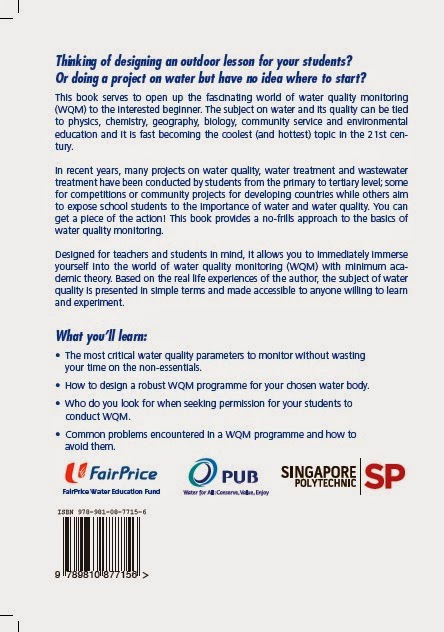
Figure: Back cover of the book

Excerpt from SP Website:
Mr Kwok Chen Ko from SP's School of Chemical & Life Sciences has written a book for the Public Utilities Board (PUB). Titled "Your first guide to water quality monitoring in Singapore", the book was presented at the opening of the Punggol and Serangoon Reservoirs on 3 July.


Water is fast becoming the coolest (and hottest) topic in the 21st century, as people learn more about the importance of water quality, and schools embark on various water-related projects. Chen Ko's book is a boost to the local environmental education scene, providing a no-frills guide to the basics of water quality. Designed for teachers and students in mind, it allows the readers to understand more about water quality monitoring programmes and even how to design one themselves!


As for the idea behind his book, Chen Ko said it stemmed from his vision of implementing a citizen-based approach to monitoring the waterways of Singapore, which is widely done in other countries, but had not quite taken off in ours.


"When I first started my first water quality monitoring in 2006, there was simply no guide for reference on such a topic in Singapore. I gathered whatever information I could from the Internet, books and journals and dived right into it," said Chen Ko.


After five years of water monitoring work and research, Chen Ko felt ready to impart his knowledge and experiences to a wider audience by writing this book.

Wednesday, August 03, 2011

Testing your drinking water - the whys and why nots

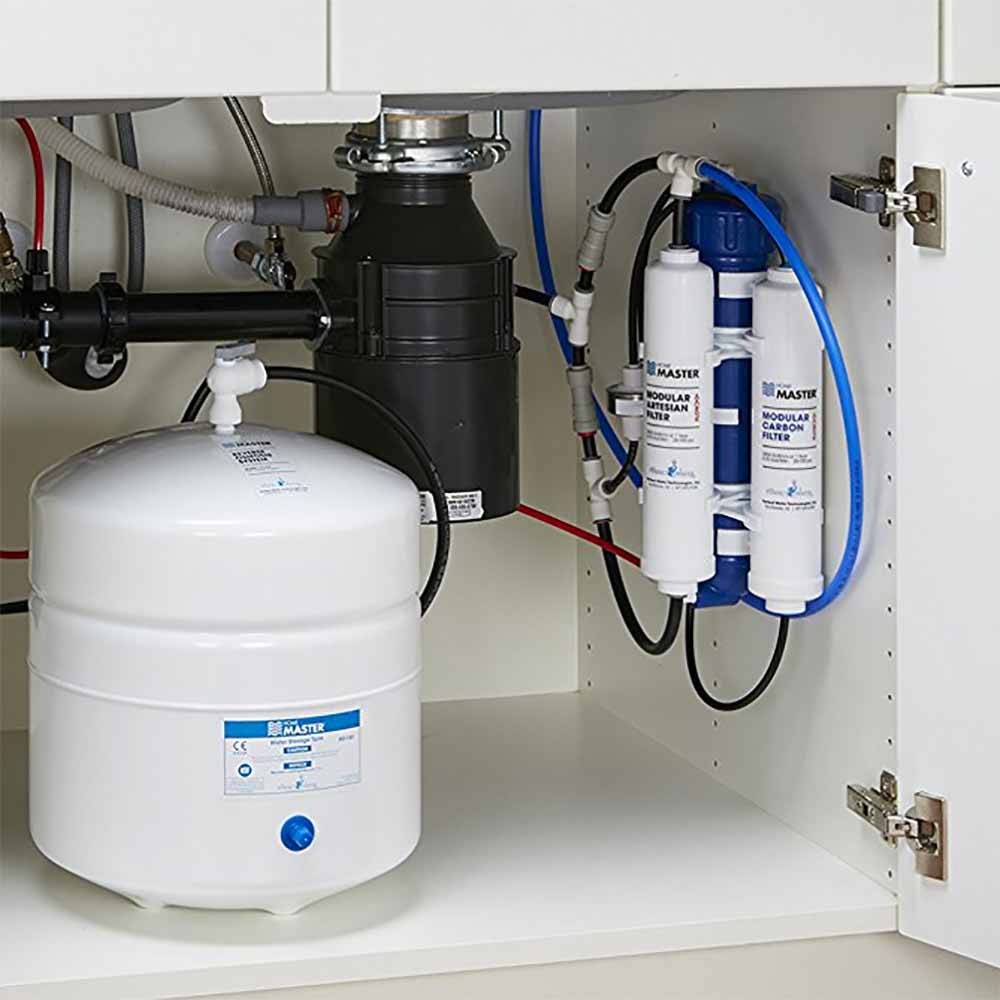
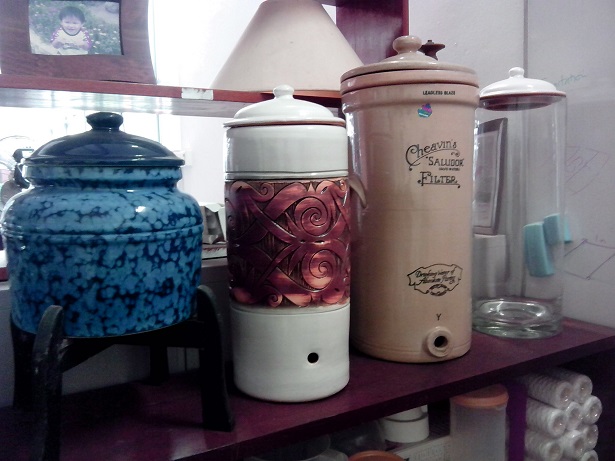
I have been receiving requests to find out more about sending drinking or filtered water for lab testing - how, why, where etc. so I have compiled a short advisory here for those interested readers out there.

Some queries are linked to the use of water filters in the home e.g. filtered water actually makes the children sick. Dear readers, for goodness sake, if you think that filtered water is making your children, just disconnect the water filter and drink tap water straight or boiled. Our tap water is supposed to strictly follow WHO's drinking water guidelines.

You are strongly urged to read through my earlier posts on water filters to get a have a better background of this post.

Why?
This is probably the most important question to answer in order to justify testing your drinking water. In most cases, the user suspects that the tap or filtered water is causing health problems in the household. At this point, it will be good to be specific about your health problem and do some research to find out exactly what substance in the water can be causing that problem. E.g. gastrointestinal discomfort? Then that could be caused by bacteria in the water.

What?
Most people say that they want to send their water samples to a commercial laboratory for analysis. But analysis is a BIG word because the laboratory will then ask them, "what components in water do you want to analyse?" This is the point when most users will leave their mouths hanging. You see, there are tens of thousands of chemicals in use today and probably several different methods to analyse each of them. Even WHO's guidelines go up to more than a hundred water parameters. It is simply not economical to analyse for so many components unless you own the water utilities company. And in general, laboratory testing is not cheap - each additional parameter to test heaps on additional cost.

Ideally, you should have answered the "why" question reasonably well so that you have a good idea of what chemicals or parameters to test for. Personally, I feel that coliform or E. coli should be a good test to start with as it gives you an idea of the level of human contamination in the water. The presence of coliform or E. coli should reflect a high likelihood of other human pathogens in the water. Other potential candidates to be tested for include chlorine, fluoride, heavy metals e.g. lead, pesticides though it really depends on your particular situation.


Figure: Testing for coliforms using the membrane filtration method

Figure: Testing for coliforms using the most probable number (MPN) method

How?
There are no lack of commercial testing labs in Singapore though they serve commercial clients most of the time. Do call them up to get a quote for testing your water according to the parameters you specified. Typically, they require a water sample to be sent over to their lab. And if you want to be scientific about it, you may to perform replication in your testing i.e. testing more than 1 sample. Some of the better known testing labs are Tuv Sud PSB, SGS Testing, Setsco Services, CPG Laboratories (a newcomer).

And if you get an "ND" in your testing report, it means "not detected". It would be smart to ask the lab what kind of detection limit (DL) does their testing method involve because ND doesn't mean something is not there or means that the water is safe. ND simply means that that particular could be present but below the detection limit  (BDL). Better still, ask the lab about the level of certainty of your results e.g. +- 5% or +-0.1ppm (parts per million). Professionals will normally know the answers to the above questions.

Interpretation of your test results could be the hardest part of the whole process. Most times, the lab is not qualified to interpret your results and tell you how safe your water is. You should always check against WHO's guidelines and PUB's typical values. But as mentioned in an earlier post, WHO's guidelines are not omnipotent. Therefore, you could be on your own to decide how safe your water is. In the case of water filters, the interpretation could be simplied by testing both the influent and effluent of your filter. E.g. if you filter is supposed to remove bacteria and yet more bacteria is showing up in your filtered water (effluent), suspect that your filter is failing you.

Final thoughts
I know... water testing is a big and sometimes formidable topic but I hope this post has clarified some of the points. I am always a staunch supporter of consumer education so please find out all you can about water testing, ask the right questions and hopefully make the right choice. Good luck.

Tuesday, July 26, 2011

Phytoremediation Question

Dear Mr Kwok,


It was a pleasure to read your post on the topic "Before you write off a plant as a weed, read this...".

I enjoyed reading the article and found the information on phytoremediation both fascinating and very comprehensive.

I will like ask if there are any regulatory or monetary policies in Singapore to be considered in regards to phytoremediation applications.

I don't seem to be able to find this information and will really appreciate your sage advice.

Thank you.

Warm Regards,

J

Dear J,


Glad to know that you enjoy reading my blog article.


Incidentally, you did not mention your purpose of using phytoremediation. In it for treatment of industrial waste? Agricultural waste? Domestic waste? Rainwater harvesting? Or simply storm water filtration? Are you using it to clean water or soil or perhaps even air?


As far as I know, there are no regulations in Singapore governing the use of phytoremediation per se. However, there are likely to be regulations controlling the end result of your phytoremediation endeavour which is tied to your purpose of application. For example, if you intend to use phytoremediation to treat industrial waste before discharge into the sewers, you will have to adhere to National Environment Agency (NEA) effluent discharge limits which may or may not make phytoremediation feasible.


Public Utilities Board (PUB) does have some guidelines (Active, beautiful, clean waters design guidelines) pertaining to the design and use of water design features (e.g. bio swales, rain gardens, wetlands) to clean up storm water.


What do you mean by monetary policy? If you are referring to monetary incentives, no, I have not heard anything. The closest is PUB is quite ready to invest in pilot-scale floating wetlands in its reservoirs (Jurong Lake, Pandan Reservoir, Sengkang Floating Wetland) and a full-scale constructed wetland (Lorong Halus Wetland at Serangoon Reservoir) to try out phytoremediation.


Phytoremediation is an emerging technique in environmental pollution control. But it lacks documentation of successful applications in this part of the world. And no matter where in the world it is used, phytoremediation takes relatively long for treatment to complete and precious land is needed grow and maintain the plants that form the heart of a phytoremediation system. Money will certainly trickle into R&D in phytoremediation though I am not sure that money will be gushing into full-scale application of phytoremediation anytime soon, at least not in this part of the world.


CK