Showing posts with label MOE. Show all posts

Wednesday, March 02, 2011

Outdoors classroom - Ngee Ann Stream

It is good to be back at Ngee Ann Stream where my water quality monitoring (WQM) workshop first started. Since then, I have brought groups on field trips to many other locales but none as charming as Ngee Ann Stream - so close to civilisation yet retaining the rustic and rural character of a lost world unknown to most Singaporeans. Despite losing some of its charm to development, I have never found another field location quite like it - a combination of different freshwater habitats, chest high Buffalo Grass to bash through, water seeping in through your shoes from the soggy soils, balancing yourself on narrow ledges, climbing down algae infested steps which are really part of a drain... the list goes on. (In KCK's list, Binjai Stream is in a close fight with Ngee Ann Stream for the most interesting waterway in Singapore but Binjai is more back to nature whereas Ngee Ann is more back to kampung so their charms are rather dichotomous.)

This time round, I have the pleasure of bringing students from River Valley High to my favourite outdoors classroom. The highlight of the trip must be the sudden heavy downpour near the end, accompanied by thunderous light show, courtesy of Mother Nature. Before this, many days have passed without rain - not a good sign as this means rain and thunderstorms become more probable with each passing day. (I know, this sounds like pseudoscience but it really works!)

Being in a canal when a big storm comes is a downright lousy place to be in - open terrain with no safe shelter and subject to flash floods which is such a trendy topic in Singapore nowadays. Being young (in age, if not, at heart) and energetic, we scurried back to the safe and dry confines of our transport in one piece. In case anyone thinks that such weather makes field trips a big no-no, nothing could be more wrong. We are living in Singapore, a country in the tropics - heavy rainfall is normal, thunderstorms are normal while shivering in an air-conditioned room all day is NOT normal nor healthy. We should not be baby-proofing nature (phrase is taken from Ice Age 3) for our youth. Given our current rate of development, I hope I won't ever see Singapore entombed in a climate controlled (aka air-conditioned) dome with nature only found in manicured parks and the only waterways are covered or canalised ones.

Ok, rant mode off... here are some pics for sharing.

Figure: Our field trip itinerary includes crossing the currently operational railway track. I always wonder what would happen to this beautiful patch of railway land when it is returned to Singapore. Will Ngee Ann Stream be further developed?

Figure: WQM in the canal. Most people don't get to climb into these canals throughout their lives.

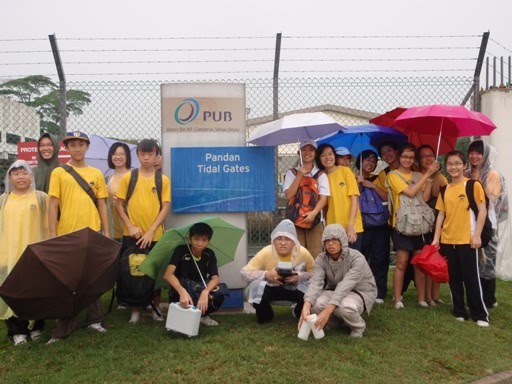
Figure: In my opinion, the best photo of the day. Heavy downpour, wet staff and students, umbrellas out if available, a sense of urgency to scramble out from the canal - something real-life, capturing the moment and not posed

Figure: Posed photo - using a colour comparator to measure the ammonia content in the water back in the indoors classroom


Wednesday, September 08, 2010

A quick update for the past months

I would like to convince myself (and you) that my packed work schedule has prevented me from posting anything since the end of May. I know it is a shame but I am also sure that inertia has played a large part - not having posted for so long propagates the said behaviour :-)

In part to prove that I am really "busy" and to update you on the past activities, here is a summary of my "work".

June - July
Conducted "Freshwater quality and biodiversity" course for Crescent Girls, Henderson Sec Sch, Clementi Woods SS, Queensway SS. It was back to a tributary (sort of a naturalised drain) of Sg Ulu Pandan for more water quality testing and bug hunting.


Figure: The group hunt (for bugs)

Figure: Don't forget the water quality parameters


Figure: Sorting out the spoils of the hunt


Figure: A rare find - freshwater eel - too small for unagi though


Figure: The common Dragonfly nymphs though perhaps not so commonly seen by the students


Conducted a round of 6-day intensive AEM (advanced elective module) "Water quality and pollution".


Figure: On first sight, nothing wrong with the scene. But if you look closely enough, lots of people are looking down on their pants and shoes. This is what happens when you venture out in the wilderness in the rain and through knee high vegetation. All manner of creepy-crawlies are out their homes, latching on to the hapless passer-by (i.e. us).


Figure: Part of Ngee Ann Stream. Looks like another canal except that this used to be a natural stream with thick secondary forest on both edges. See next figure.


Figure: The same part of Ngee Ann Stream as the figure above but a year back. Note the vegetation stretching right to the edge of the secondary forest stream


Figure: An unusual find - a catfish struggling against the current in the "canalised" Ngee Ann Stream. Why was it doing so? I have no idea. Perhaps it should have just flowed along with the tide of change as what the rest of the stream did when it gave way to "development".


Figure: Due to the earlier heavy rain (what else is new in Singapore?), the whole canal was flooded, preventing the students from sampling the water (too dangerous).


Figure: The same part of the canal as the figure above but in drier times and more than a year back.


Figure: I simply can't resist putting in this routine group photo. Must show that the participants are in good spirits, right?


Singapore International Water Festival (27 Jun 2010)
Once again, I was roped in to organise the event "Amazing Greenviron Challenge" - an environmental quiz of sorts with indoor and outdoor components at the Marina Barrage. Weather was terrible in the morning so the outdoor part has to be moved indoors. (Right, rain was indeed heavy in June, giving rise to the shocking floods in downtown Singapore.)


Figure: Only 1 photo to show you here - the super group photo with organisers, student helpers and participants.

(Are we not done with the summary yet??? Afraid not... Did I mention that I had a tight schedule then?)

Water Quality Monitoring (WQM) (19 Jun 2010)
Amidst the tight schedule, I managed to sneak in a round of WQM with Team Seagrass at Chek Jawa.


Figure: On this rare sunny June morning, my students prepared their equipment for WQM.

To top it off, I attended the 4-day Wilderness Medical First Responder (WMFR) Course by OBS (Outward Bound Singapore) on Pulau Ubin. More on this in a later post.


Figure: WMFR participants and our dummies

WQM at Pasir Ris
Ah yes, the problematic kid on the block with regards to water quality - Pasir Ris Beach. (The latest advisory on its "fair" water quality is found here.) We checked out this notorious locale on this rainy July morning. Perhaps unknown to most people, this stretch of sand hosts 2 significant patches of seagrasses even though they are not monitored by Team Seagrass. (Some of the Team's members do however check out the seagrasses here in their own capacity.) And since there are seagrasses here, my team will of course be interested in the WQ.


Figure: 1 patch of seagrasses near Sg Loyang


Figure: The 2nd patch of seagrasses near Sg Tampines. I was told that there is a smaller patch further west near the end of Pasir Ris Park. We did not check this one out though.

Friday, May 07, 2010

Water quality monitoring (WQM) project in Japan

Here is another secondary school working on WQM but this is the first one I have seen operating in Japan! WQM aside, it seems our schools are going around the world quite a bit. Environmental projects seem to be a common theme for such overseas trips. And WQM is usually in the forefront of such environmental projects.

School:
I have a challenge here which I hope you may be able to advise.  I’ll be bringing a group of students to Japan Kurihara in early June with an objective of doing an investigative project on environmental issue.  After much brainstorming, the students would like to do a water quality project.  Brings to mind of your course. 


With our initiation in the coming trip, we hope our sister school in Japan will be able to follow up with periodic collection of data and hopefully make meaning to the data.  We are not sure at this point what kind of data to collect.  We can bring along dataloggers and sensors like pH, temperature and dissolved oxygen.  But we are uncertain if our sister school will have the equipment to continue collecting such data.  Please advise what meaningful data that we can collect and yet not be so imposing on our Japan’s school.


Even without dataloggers, meaningful data can still be collected with regular spot sampling.


Here are some suggestions.

1. pH
Get some universal pH paper which shows reasonable resolution i.e. instead of simply acidic or alkaline, the universal pH paper will measure pH from 1 to 14 based on a colour scale.


2. turbidity
Turbidity in water can be measured using a Secchi disk. In fact, you can get the students to make their own disks. Basically, it is lowered into the water till the disk can no longer be seen. This depth is then recorded.


3. temperature
Easily measured using thermometers though try to get the non-mercury types instead of mercury ones which may break and pollute the water.

4. Settleable solids
This test measures the amount of settleable solids in the water. Strictly speaking, you need to get an Imhoff Cone for the job but I suppose any measuring cylinder will do if the budget is tight.


5. River flowrate
A quick and dirty method is to float an orange downstream within a predetermined distance. Time it and calculate the speed. Better still, estimate the cross-sectional area of the stream and multiply this by the speed to get water flowrate. Besides science, this also tests the math ability of the students.

Of course, if your sister school has the budget, they can procure reasonably priced portable pH meters and conductivity meters (~ S$100 for a low-end one). These will give more precise readings and may be economical over the long term. Digital DO meter tends to be pricier so get one only if they have the budget.

There are also relatively low priced water tests involving chemicals e.g. DO, hardness but depending on the students' ability and the school's budget, these may or may not be suitable.

Good luck!

Monday, April 19, 2010

1-day course on water quality for teachers: My forest is dying and the role of water quality

Are you thinking of designing an out-of-classroom lesson for your students?

Have you considered water quality monitoring (WQM)? It can be tied to subjects like chemistry, geography and biology. Elements of community service and environmental education may also be incorporated in a WQM session.

There is currently much interest on water from the top (government). Perhaps because of this, much interest has been generated from the base (e.g. schools) too. In recent years, I have observed many projects on water quality, water treatment, wastewater treatment etc. from primary to tertiary level. Some projects were entered for competitions, some became community projects for developing countries while others aim to expose school students to the importance of water and water quality.

WQM involves checking the health of waterways on a regular basis. Whether in natural streams or urban canals, most of the water ends up in our reservoirs which provide our drinking water. Hence, WQM plays a vital role in safeguarding our water supplies.

WQM can become an on-going community service project. For schools in particular, WQM brings students into the field to experience real science and covers the part of their curriculum on environmental education and place based education (PBE).

If you are interested, you can find out more about the fascinating world of WQM in this course. Teachers and MOE staff may sign up for it via Traisi. For more details on the course, click here. Write-up of previous runs may be found here - 1, 2.

Course title: My forest is DYING and the role of water quality
Date: 2 June 2010 (Wed)
Time: 0900 - 1700
Venue: Singapore Polytechnic and in the field

Some further information:
I have regularly performed WQM with my polytechnic students since 2006. My publications include articles in Nature Watch and Nature News. I am currently continuing my WQM work with Nparks and Team Seagrass in Singapore's natural and coastal areas. My training courses (1, 2) on WQM have been regularly attended by students (primary, secondary, JC) and MOE teachers.

Tuesday, April 06, 2010

The forgotten mangroves at Sungei Pandan

Talk about mangroves in Singapore and you will hear about places like Sungei Buloh, Pasir Ris, Pulau Ubin and from the savvy ones, Sungei Sembawang, Sungei Punggol, Pulau Tekong. Only from the most experienced naturalists will you pick up whispers of Sungei Pandan. If you look up "Longman atlas: Singapore and the world", you won't even find mangroves there.

There is a very good reason too - Singapore's northern coast is well suited for mangrove building with gentle currents for sediment deposition. Yes, you need to have accumulation of the "yucky muck" for a good substrate. Sungei Pandan mangroves thus appears to be an odd orphan located near the southern coast. Could the conditions at Sg Pandan be similar to those of our northern coast?

I simply can't resist taking my advanced elective module (AEM) class to this interesting habitat for a water quality monitoring (WQM) field trip.

Figure: A massive dam lying right across Sg Pandan. Such dams are common on rivers and canals leading to the sea (Marina Barrage is the big brother among them). They control the loss of fresh water into the sea so that the reservoir (Pandan Reservoir in this case) can be pumped up. Another important function of a dam is to prevent the flow of seawater (read salty water) into the reservoir. Treatment of salty water is expensive since you need reverse osmosis or distillation to do the job. Conventional water treatment does not cut it.

But... (there is always a "but") these dams also disrupts the continuity of the flow, separating the stream into 2 parts with distinct characteristics, one of which being salinity. (1st hint: take note of the vegetation on the bank in the above figure.)

Bad for the aquatic life but great for an outdoor lesson. Here is a Google Earth file compiling the data collected by the participants.

Aside to FMSS students in selected groups: Please use this file to prepare for your case study presentation.

2nd, a dam may prevent precious sediment from reaching downstream. To you, sediment may be muck; to the creatures downstream, it is food, nutrients, home and more. Just as sediment is blocked, the migration of animals for spawning, feeding etc. across the great divide in both directions is also hindered. I am sure environmentalists all over the world have more to say about these dam problems (1, 2; Mekong - 3, 4).
 
Figure: Steady rain for the whole field trip but what the heck, we are living in the tropics - rain is a standard feature. As long as safety is not compromised (e.g. lightning), some work in the rain is good for the spirit.


Figure: A denizen of the mangroves cleverly avoided the rain by following the guy with the umbrella

Figure: Downstream of the dam. Spot the different root systems of mangrove plants. The exciting mangroves in this figure is a vivid contrast to the boring grasses (no offence to the grass people) upstream.

Figure: Mudskippers surfacing to enjoy the cool rain which keeps their bodies comfortably moist.

Thursday, March 18, 2010

Next run of MOE workshop: My forest is DYING and the role of water quality (2 Jun 10)

This workshop on the theoretical and practical aspects of water quality monitoring in Singapore is scheduled to run on 2 Jun 2010 (Wed).


From my past experiences, I have immensely enjoyed teaching this course and most participants have given encouraging feedback.
Writeup of previous runs may be found here - 1, 2.

MOE teachers and staff may enrol for the course in Traisi.

Wednesday, March 10, 2010

AEM: Water quality and pollution (Mar - Apr 10)

It always feel good to get into teaching water quality monitoring (WQM) to students. No doubt, you can argue round and round about the benefits to the environment, the next generation, the world etc. but ultimately, the teacher/instructor has to be passionate about what he teaches. If not, all the other reasons do not matter.

Here is the latest batch from Fairfield Methodist School (Secondary).

Figure: Introduction to WQM by having a "field trip" to the nearby fish pond. Notice the student in the foreground wearing slippers. He became the first "casualty" when he slipped into the water. Yes, such things happen, even in a controlled environment like a fish pond.


Figure: Basic data collected on the fish pond. They seem to indicate that the fishes are having a good time in the well maintained pond.

Thursday, January 28, 2010

Courses on water quality

In response to queries about my courses on water quality, I have listed them here for easy reference.

  1. AEM (advanced elective module): Water Quality and Pollution
    This 40-hour module is essentially for upper secondary school students as dictated by MOE (unless the school is willing to forgo the MOE subsidy).

    Check out this post for more details.
  2. My forest is DYING and the role of water quality
    This 1-day course is mainly catered for MOE teachers even though MOE HQ staff have attended it. I was initially told that the course title sounded wacky and school management (the approvers for my customers - teachers) would not be amused with such a title. However, many participants found the title catchy and wanted to learn more about the course. Hence, the title stays as it is.

    Check out the course details here.
  3. Water Quality in Natural Habitats
    Another 1-day course. This is more suitable for secondary school students and above as it involves laboratory work in addition to the standard (at least for me) field work plus classroom lesson.

    Check out the flyer here.
  4. Freshwater quality and biodiversity
    Duration of 1 day too. This course is suitable for primary school students and above. There is no laboratory work. Instead, the participants get to see aquatic bugs (macroinvertebrates) up close and personal - an  unforgettable experience to most since people in Singapore hardly go out to "play" with nature anymore.

    Check out the flyer here.

FAQs on AEMs (advanced elective modules): Water Quality and Pollution

  1. What are AEMs?
    Check out characteristics of AEMs
  2. What are the dates and times?
    The teacher in-charge will have to work out the schedule with coordinator of the AEM (typically a Polytechnic lecturer). Each module is 40h so it will take about 5-6 full days either condensed into a week or spread across several weeks.
  3. How many participants are required?
    Minimum 20. I normally stick to a maximum of 20 for safety reasons, especially in laboratory and field work.
  4. When must I give you the list of participants?
    The name list can be sent to me latest 1 week before the course starts.
  5. What is the cost?
    <
    br>$400 per pax. MOE can subsidise $345 with $55 coming from the student or school.
  6. How do we go about applying for the MOE subsidy?Check out application of funds for running AEMs
  7. Are teacher required to be present?The presence of a teacher is preferred, especially for the field trips.
  8. What is the AEM, Water Quality and Pollution about?Check out my flyer or the description
  9. If I need more information, who can I approach?For further clarifications on policy and implementation issues, please contact:

Thursday, December 10, 2009

"Water quality in natural habitats" course for Jurong Junior College (4 Dec 09) - field trip to Ngee Ann Stream

Junior colleges are now getting into the act of water quality monitoring too. After all, this activity neatly ties up many disciplines such as geography, chemistry, physics and biology, allowing the students to appreciate how science works in the real world (which may not resemble anything like the theories in books).

Reality check - we were into the month of December within the period of the Northeast Monsoon. Rain was expected but expecting it did not make things any easier. Heck, this field trip was the wettest I have ever led since the rain started before, lasted during and ended after the whole trip.

Frankly, I was really relieved when I saw that the students were prepared for rain. To their credit, this was one of the best bunches of participants I ever had.


One common problem, whether raining or not, was someone's shoe(s) being totalled (i.e. sole came off) in the mud and rough terrain. See below for the end result. Thankfully, the hapless victim was resourceful enough to tie up the mess into a walkable vessel using a shoe lace.


True to rumours, the area adjacent to The Sterling (a condominium) was cleared bare. There goes the nice forest setting. This makes me wonder how long Ngee Ann Stream can endure before it is gone for good. The machines were still clearing up remnants of the forest. (More condos coming up?) The delineation between cleared area and vegetation is shown below (the stream is to the right).


Major obstacle. Because of the downpour, the canal was flooded to waist level with rapid flow. The bottom of this canal would have been 2 of my sampling stations. Worse, we need to walk along this canal to reach our rendezvous with our transport back to campus. In view of the risks, we took an alternative route back to the starting point and had to forgo trying our luck in the rapid waters of the last 2 sampling stations. People, if you want to conduct a field trip, it pays to know the area well. Also, think hard for alternative exits in case a quick evacuation is necessary.

Fast flowing waters leading to the canal.


Back in the comfort of air conditioning and soft cushions.


What was that odd smell in the air? Just students drying their mud soaked shoes.


Working on the analysis of water samples using testing kits.


My favourite tool for field trips - African walking stick from Cold Steel. Modelled on the walking stick used by Zulu tribesman but made of polypropylene rather than wood. Virtually indestructible and superbly useful - prod the ground ahead for concealed trenches, clear bushes out of the way, balance oneself uphill or downhill, reach out to participants who need to be pulled to safety and of course discipline the occasional recalcitrant participant who insists to do things the hard way... (just kidding for the last point)

Thursday, November 19, 2009

Freshwater quality and biodiversity for primary schools (9, 13 Nov 2009)


Primary schools are finally getting into the act of water quailty monitoring! (Thanks to Audrey for the link-up.) I have always felt that the water quality in our natural areas and man-made water bodies (e.g. reservoirs, canals) can never be taken for granted. While Public Utilities Board (PUB) has done an excellent job in monitoring and maintaining the water quality in reservoirs, the rest of our water bodies are poorly monitored, or neglected altogether. We really do not know what is going on inside all these waters!

The other activity that I feel strongly about is education. If done right, education can solve many of today's problems - environmental, social or otherwise. And you can never start education too young. Given proper exposure, the children of today will grow up with a sound awareness of the environmental issues challenging our world and become staunch stewards of the environment tomorrow. However, without good old hands-on experience, how do you expect them to appreciate the importance of good water quality and acknowledge their connectivity to the environment?

Over a period of 2 days, Queenstown Primary, New Town Primary and Pei Tong Primary have their students participating in my course on freshwater quality and biodiversity. I must admit that facilitating primary school students is very different from facilitating secondary school students and more so compared to polytechnic students. But this adds to my overall learning experience so no complaints here.

If you are expecting to see 40 kids running around the field with their teachers (and me) shouting to keep them from hurting themselves (e.g. falling into the water), you are not too wrong. But it is exactly this infectious energy that fuels their enthusiasm and unprejudiced questioning. To them, curiosity is asking about what they do not know without fear of ridicule or embarassment. Their attitude is a refreshing change from the reserved nature of older students.

As always, field work is a must for my courses. There is no substitute for real world experience. However, the less predictable nature of the field is also present, culminating in a heavy downpour during our field trip. With some quick thinking, the field session was salvaged by substituting with an outdoor lesson under a nearby highway bridge. (We were pretty safe as the whole area under the bridege was concretised.)

Figures (L-R, T-B): Inspecting leeches (again!) under the shelter of a highway bridge; Andrew conducting a lesson on water ecology under the same bridge; in brighter weather, Andrew does the same lesson next to the pond; students checking out aquatic life at the pond; on-site testing of water quality; the mandatory classroom photo at the end; downpour!


Thursday, June 04, 2009

Workshop/course for MOE: My forest is DYING and the role of water quality (Ngee Ann Stream, 4 Jun 09)

If there is a "best job in the world" for me, this is it (for now). How often does one get to work on something one enjoys and get paid for it? (Admittedly, my pay is small change compared to what Ben Southall is getting for being Islands Caretaker starting 1 July.) In my case, I get to breathe nature's fresh air, perform water quality monitoring and teach all in one day. Of course, I must commend my participants for being such wonderful learners and clients to make this course so smooth.


For the educators out there who have never conducted field trips before, let me tell you what you have been missing. No doubt, your participants may complain vehemently during the trip - the usual mozzies, mud, slippery slopes etc. But you can bet that 9 out of 10 of them will feel glad that they made it for the trip which more often than not is voted as the highlight of the course.

The bonding you see in the participants is priceless. In no other courses (without field work) will you ever see such active and mutual support among the participants. The tougher the trip, the more pronounced this is.


This is of course nothing new to groups engaged in outdoor pursuits e.g. cadet corps, rockclimbing, trekking. A variant of this observation has been drilled into me all the way from my scouts days to my army daze. "If people suffer together, they become more united." I certainly do not believe that suffering is necessary in my courses but a little discomfort will go a long way in providing an enriching experience to the participants, mentally and physically.

On a gentler note, I sincerely believe that nobody wants to let his team down. He will try his utmost to fulfill the team's mission even if that means facing discomfort or worse.

After all, how often do you hear your particpants proudly declaring, "we have conquered Ngee Ann Stream"?

Figures (L-R, T-B): Ladies (busy) at work; going out on a limb to get the job done; holding on to one another and the "railing" to navigate the slimy floor; the whole Team at work; group photo at one of the more scenic spots; displaying the badges of honour - muddied shoes and feet; climbing out of the frying pan...; safe and sound in the classroom.