Showing posts with label Chinese Garden. Show all posts

Thursday, February 28, 2013

Question about Lorong Halus

Hello Chen Ko

My name is B and I came across your blog (http://waterqualityinsingapore.blogspot.sg/2011/04/latest-wetland-craze-lorong-halus.html) while trying to find out more about the health risks of running in the possibly leachate-containing mud trails near Lorong Halus landfill (I browsed your blog and I realise this might not be your area of expertise but I would appreciate any insight at all :-) ).


I live near to Sungei Serangoon and have recently started running at and exploring the area around Lorong Halus (it's an awesomely beautiful area with lots of wildlife - and I share your love of nature and I'm also concerned about how successful these new wetlands will be - the undeveloped east bank carries so much more biodiversity than the developed west bank which is Punggol Promenade and HDB flats).

On several trips recently I've been exploring the dirt trails that run along the east bank of Sungei Serangoon, and up and down one tributary just south of Lorong Halus Wetland (it leads up to Lorong Halus near the TPE entrance), and I've been running across what looks like leachate, especially near the green pumping stations:

1. Most commonly orange-ish puddles/mud similar to these:

http://www.soilenvironmentservices.co.uk/images/projects/7_landfill_leachate_metal_contamination.jpg

http://www.wolfenotes.com/2010/06/dep-calls-toxic-landfill-leachate-natural/

2. Oily rainbow sheen on puddles/mud

3. (least common) Black fluid leaching into some puddles

There's no way to avoid these so I've been getting my feet into them, and though I don't really intend to return to those trails in future, I was concerned about how toxic these are, and I was wondering if you have any idea? (I've done some googling and found that (as per your blog as well) the common hazards are heavy metals and toxic organics - PCBs and dioxins?) These areas are not open to the public currently, but there are trails used by foreign workers who fish there (probably from the dorm at Tampines Road near Old Tampines Road).

Here's thanks in advance for any advice you can provide. :-)

Best regards and happy trails!

B


Hello B,

First off, here is a quote for the purpose of Lorong Halus Wetland. "Using an innovative bio-remediation system, national water agency PUB designed the Lorong Halus Wetland to collect and treat water passing through the former landfill, preventing it from flowing into Serangoon Reservoir." (1, 2)

My stance is I would not say that leachate is escaping from the landfill without rock solid proof.

Unfortunately, environmental forensics is often a complicated and expensive activity. Imagine gathering numerous soil, water and solid waste samples from many locations and testing them using sensitive AND expensive equipment in the lab. When the data come out, you still have to interpret them to build up a useful case. One method is to obtain a chemical "fingerprint" of the liquid oozing out of the earth to match that of the solid waste in the landfill. Perhaps the solid waste has a very specific pattern of chemicals (this gives you the "fingerprint") not found anywhere else in the surroundings. If you can positively detect the same patternin your liquid, voila! Then you may have a case.

But we are talking about the environment here. Many physical, chemical and biological processes (both human and natural) are occuring at the same time and these can alter your "nice" pattern of chemicals in unpredictable ways.

Or perhaps you can't find any usable "fingerprint". All is not lost. Another method involves injecting a tracer chemical into your landfill and see if it ends up somewhere else in the surroundings. Obviously, this tracer should not already be in the environment and should be easily detected. A good tracer can be radioactive for ease of detection though it may not be so friendly to the ecology. Some applications have used your familiar salt as a tracer so if your streams suddenly turns salty, you know where it comes from. Same thing here - your ecology may not like such an influx of salt much.
Even if you can afford the time and money, at the end of the day, your tonnes of data may still be inconclusive to prove that leachate is indeed escaping from a landfill. I guess this is quite similar to criminal forensics in which your evidence is based on probabilities e.g. 95% confidence level. What is not to say that the heavy metals and toxic organics in your puddle could have come from the metal processing plant a kilometre away?
In response to your observations:
  1. "Orange-ish puddles/mud" are often caused by the presence of iron. Iron from soil (especially in Singapore soils) leaches out to the surface and form precipitates (orange solids similar to rust). This process can be facilitated by iron bacteria which "eat" (the chemical term is "oxidise") the iron for energy. Iron bacteria is easily identified by a orange/brown gelatinous slime.
  2. "Oily rainbow sheen" can indeed be due to oil, especially if there is iridiscence. But it can also be caused by iron/manganese particles from the soil. A simple way to find out is to use a stick to disturb the sheen. If the sheen breaks up into pieces, it is probably iron/manganese. If the sheen swirls around and follows your stick, it is probably oil. Even if it is oil, it can be from natural sources e.g. plants, dead animals.
  3. "Black fluid leaching into some puddles" can also be from nature. Is your fluid thick and viscous like engine oil? Or is it more like tea - black/brown yet clear? Tea coloured water can simply be tannins from decaying vegetation or humic substances (also originates from vegetation) from soil.

In essence, smoking gun evidence or even probable cause is hard to come by without further investigation and chemical testing. But if you ever find mass or sudden kill of plants or animals in the area, that is certainly a cause for concern though leachate may still not be the culprit.
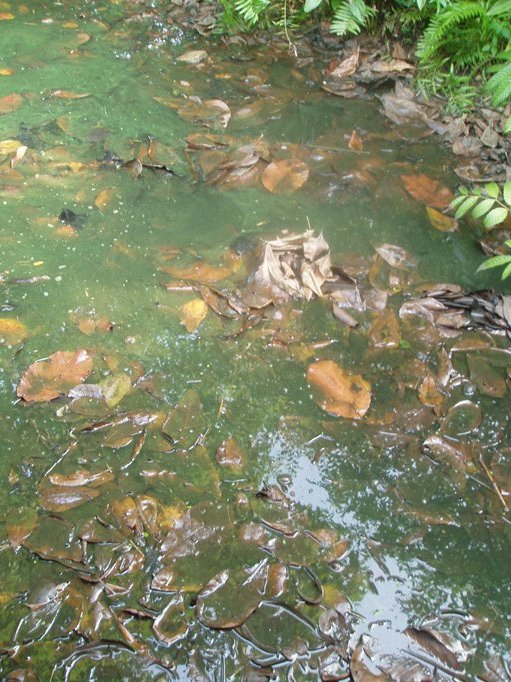
Figure: Iron bacteria in a stream in Chinese Garden (Apr 2011). It can be a big aesthetic problem.

Figure: Iron bacteria in a small tributary at Ngee Ann Stream (Feb 2008). Even the vegetation were coated brown.

Figure: No, this is not sand. More iron bacteria on the canal bed at Ngee Ann Stream (Feb 2008)

Figure: Oil sheen on canal bed at Ngee Ann Stream (Feb 2008). Notice the iridiscence in the sheen.

Friday, December 16, 2011

Question on phytoremediation

Dear Mr Kwok,


My name is C and I am a marine life enthusiast like yourself. I recently had the opportunity to visit a few fish and shrimp farms in Brunei. These farms are in land farms beside the coast. I noticed that in some of the ponds the water is obviously highly toxic with large amounts of foam floating on the surface. Owner confirms that the water in these ponds have not been changed for 1-2 months.

As each pond is approximately 10 metres by 25 metres and 2 metres deep, each farm has 40-50 ponds, it may be expensive to perform frequent water change such as those done by owners of reef aquariums.

So if there are say 20 such farms in the area, each discharging the waste water directly into the sea, wouldnt the water quality in the area be adversely affected?

The question I have for you is this:

1) In a reef aquarium, we use a protein skimmer to remove dissolved organic materials and water changes to dilute the toxic compounds in the water. This is obviously too expensive for commercial fish farming. Some hobbyists have experimented with using mangrove saplings to remove dissolved organics as a replacement for the protein skimmer. Is it possible then, to grow mangrove on floating pontoons in the fish pond? Would this be a cost effective way to improve water quality in the pond and there by improving food safety?

2) What are the issues we might have to think about if we want to plant mangrove on floating pontoons?

Thanks and regards,

C


Dear C,

You may want to read through my posts on phytoremediation 

especially Singapore latest water attraction - Sengkang Floating Wetland and Before you write off a plant as a weed, read this


There are certainly many issues involved in phytoremediation via mangrove plants on floating pontoons aka floating wetlands, from conception, evaluation, design, implementation, operation to management.


I will attempt to touch on those that are close to my heart though I am sure there many other important ones which I will miss out.

1. I assume you want to use mangrove plants (I suppose you are referring to the tree types) because the water is brackish or salty. I strongly believe mangrove trees have a lot of potential to perform phytoremediation, especially removal of nutrients from pond water. However, though widely used in Asia and other tropical countries, documentation of their implementation and effectiveness are still lacking compared to other “traditional” phytoremediation plants. Certain salt marsh plants (e.g. cordgrasses, seaside rush) have been documented to be successfully used in brackish/salty water. Nevertheless, I would still encourage you to try mangrove trees since they are very much part of our natural heritage.


2. Cost! This can be a big issue if you are using any of the proprietary floating mats for holding your plants. There are many high-tech mats out in the market and they will cost you more than having a similar constructed wetland built on land. Alternatively, you can go the DIY route. I have seem floating platforms made out of bamboo, plastic bottles and other recycled materials.


3. One gripe I have with floating wetlands is their short reach with respect to the depth of the water body. You mentioned that you intend to use such floating wetlands to remove dissolved organics. Ideally, you will need a good root system well distributed laterally and vertically in the pond to achieve that. The root system allows bacteria to flourish and these are the guys on the ground removing your organics. Hence, the mangrove roots will need to go as deep as possible but a floating mat by its nature can impede the spread of the roots.


4. What about harvesting? Do you intend to remove the plants periodically? What if they grow too big for your mat to support? On the other hand, you need your plants to be big to be efficient in phytoremediation (think more biomass to absorb the nutrients or more roots with longer reach for bacteria to grow). Of course, harvesting and replanting will incur more costs.


Good luck!


 Figure: a DIY floating wetland in a pond in Chinese Garden

Figure: Rhizophora sp. in Sungei Buloh Wetland Reserve - a mangrove tree that has potential in phytoremediation, especially in brackish/saline waters

Monday, October 03, 2011

Water quality monitoring workshop for CUGE

I had the opportunity to conduct an inaugural water quality monitoring (WQM) workshop for CUGE (Centre for urban greenery and ecology). The participants were mostly Nparks staff. Before this, I had only worked with MOE teachers and students in my WQM courses.


It was indeed an eye opener. With their outdoor experience, my field trip became a non-issue. No complaints about the mozzies, the mud or the weather.

In fact, I dare say this field trip to Ngee Ann Stream was my most challenging. A huge tree has fallen over the path I normally took my participants. There was no clear path through it or around it. Fortunately, a hardy participant (L) came forward to blaze a trail through the fallen tree while I was wondering whether the rest were able to handle such bashing through. Reminding myself these were Nparks staff, everyone came through without a scratch despite the big ants scrambling all over the branches in protest of our intrusion. A few other “garang” types helped to clear the trail as L and I took the lead in our trailblazing.

Because of the wet weather earlier in the day, the canal was flooded. Usually a convenient way to cover ground, the canal became out of bounds. Since these guys and ladies were as good as I thought they were, I decided to do another round of bashing through a patch of tall grasses. Since these were only grasses (not trees or shrubs), I used my handy walking stick to sweep the blockage aside. Problem solved.

Though most of the participants have no chemistry background, they were thrilled with trying out the water testing kits back in our classroom. Designed for field work and hence simple to operate, most participants took an instant familiarity with the kits’ usage. In fact, they were more than enthusiastic to stay after 5p.m. to finish their water testing with the kits. It is always a pleasure to observe students with a passion to learn and experiment.

Figure: My favourite monitoring station along Ngee Ann Stream. A good shady spot for the participants to rest after the "gruelling" hike through tall grasses and steep slopes. Notice the tall grasses in middle - we had to bash through those after this station.

Figure: This canal is normally dry with only a small flow in the centre. On this day, an earlier rain has made the canal impassable. Even the participant has to collect a water sample on the steps. Not for school students.

Figure: Using water testing kits back in the classroom

Figure: Participants putting up their water quality data for all to see and compare.

Figure: Bug hunting and identification at Chinese Garden

Figure: We had the rare chance of checking out what Chinese Garden has implemented its admirable efforts to go green. This is a phytoremediation project to treat and reuse grey water from a toilet's sinks.

Update: Here is the link for a write-up of the workshop on CUGE' website
http://www.cuge.com.sg/October-2011 > 04 Oct 2011 - A Fun and Enriching Hands-on Experience Sampling and Testing Water

Saturday, July 23, 2011

How to get rid of your seemingly unstoppable pond algae

Excessive growth of algae (aka algal bloom or eutrophication) is not a new problem in Singapore. You can sometimes see a canal or even a reservoir taking on an unnatural greenish or bluish tinge. For the aquarium hobbyist, it is just as tough a nut to crack as the algae is removed physically, chemically or biologically, only to return with fresh vigour after a while, seeminlgly impossible to kill.


Figure: "Orange" algae in stream in Chinese Garden (Apr 2011)


 Figure: Pond badly overgrown with "green" algae at Sungei Buloh Wetland Reserve (SBWR) (Mar 2011)


Figure: Another shot of the same pond in SBWR (Mar 2011)


With a sprinkling of scientific principles, here are my sentiments on curbing this tough guy.

First: scoping out your opponent
Find out who this tough guy really is. Algae comes in all sorts of flavours, from red, green, blue-green, brown to diatoms and dinoflagellates. To really nail it down to species level, you will need molecular techniques in well equipped labs. Since most of us do not have access to such high powered stuff, we will have to settle on visual examination under microscope. (I agree that most of us do not have a microscope stashed away at home either but at least most schools should have a few to play with.)
 Figure: Microcystis spp under 10x magnification

Figure: Anabaena sp under 10x magnification


Once you have an idea of your guy, check out his characteristics. How does he grow? What are his most important nutrients? Which nutrient is the limiting one? In the case of the above 2 algae, they normally bloom in an excess of phosphorus usually in the form of phosphate.

Second: scoping out your water
Hey, this is water quality blog so yes, you have to check out your water quality. The standard parameters include: dissolved oxygen (DO), electrical conductivity (EC), turbidity, pH, alkalinity, hardness, nitrate, ammonia, phosphate, biochemical oxygen demand (BOD), chemical oxygen demand (COD). Feel free to add more if you have the resources but the above should be a good starting point. Throw in chlorophyll a (a chemical found in algae) if you think you are up to it.

Go through your water quality data. Is there anything wrong besides the algae you observe? Anything amiss could point to some systemic problem that might have triggered the algal bloom. Following the above examples of Microcystis and Anabaena, the phosphate level is likely to be elevated.

Comparative studiesUnfortunately, it is hard to define what is meant by elevated in a natural environment impacted by numerous uncontrollable factors. One way is to make comparisons. Ideally, you should compare the same variable against time i.e. what was the phosphate level 1 year, 5 years, 10 years ago. Unfortunately, almost no one in Singapore (short of PUB in their reservoirs) does regular long term water quality monitoring (WQM) of their water bodies.

The alternative is to compare against a nearby "clean" water body. Since it is algae free, does it have a lower phosphate level?


Third: scope out your environment
Assuming you have discovered elevated phosphate level in your algae infested pond, ask: where does it come from? What are the sources of water flowing into your pond? Does surface run-off carry fertilisers from your next door vegetable farm neighbour into your pond?

You may have to check historical records too as your pond  may be sitting on an old farming area. If your pond sediment is choked full of phosphate from chicken waste from the previous chicken farm, you will have to get rid of the sediment.

I am all for long term solutions so learning the source of problem and tackling it at the source has always been my principle.


Fourth: ACT
As mentioned earlier, you may have the option of physical, chemical and biological methods.

Physical
Drain your pond and dredge out your sediment if it is the source of phosphate. You may also mechanically remove your algae via nets and filters

Chemical
Add alum or other chemicals (there are quite a few exotic ones in the market now) to bind the phosphate in your water into solid form and remove the solids.

Biological
By the nature of their operations (e.g. nature parks), some organisations are reluctant to use physical and chemical methods. Biological methods like phytoremediation appears appealing because of their naturalness. Yet, they may not pack the punch necessary to remove the nutrient (e.g. phosphate) sufficiently.
Other actions
Naturally, if the source of nutrient appears to come from your surroundings, you probably to get your neighbours into the picture to discuss ways to resolve your problem.

Thursday, April 28, 2011

Checking out the water quality at Singapore's iconic (but mostly forgotten) landmark: Chinese Garden

Some time ago, I was lamenting about the lack of water bodies in Singapore for educational activities. I now realise that I have missed out a wonderful outdoors location for my water quality studies and it is none other than our iconic Chinese Garden. (The nearby Japanese Garden and Jurong Lake Park should also fit the bill as outdoors classrooms though I have yet to check them out.) When I was younger (decades ago?), Chinese Garden was always in the spotlight for shooting of period drama serials by the then SBC (Singapore Broadcasting Corporation) (now Mediacorp). Nowadays, it is mostly forgotten except for a handful of joggers, photographers and tourists. The latest attractions in town are the sexy casino and theme park on Sentosa, as well as the panoramic sky garden and another casino at Marina Bay Sands.Chinese Garden is so "history".

What prompted me to check out Chinese Garden was a friendly meeting with the management of the Garden under JTC (Jurong Town Corporation). They are really supportive of promoting the 2 gardens and 1 park for educational purposes - outdoors lessons, water quality studies, even relevant R&D. Do approach them if you think that they fit your educational curriculum as I am sure they will oblige your request.

Enough chatter. Here are some of the findings on my trip there.

Figure: A rather commonly encountered aesthetic problem is the obvious presence of algae in a few streams and ponds. We didn't try doing any sampling for fear of allergic reactions to algae and their metabolic products.

Figure: Quite a few healthy patches of cattails. We tried sampling for bugs (macroinvertebrates) here as such densely vegetated areas are their favourite haunt.

Figure: A small water body at the dead end of a stream. Because of the lack of flow and circulation, the end of this pond is occasionally overwhelmed by suspended sediments. We also did a sampling of the bugs here.

Figure: Sorting out the bugs from our water sampling. Surprise, surprise... there are healthy populations of various bugs despite the aesthetic problems mentioned above. Lots of shrimps, damselflies, some dragonflies, quite a few mayflies, water bugs, almost no worms and no leeches. The water is biologically (and implicitly chemically and physically) healthier than most water bodies I have sampled in Singapore. Make no mistake, Chinese Garden is THE place to visit for water quality work.