Showing posts with label Sungei Buloh. Show all posts

Sunday, March 24, 2013

Overseas community service (OCS)/ Youth expedition project (YEP) part 3: Are there still more things to check if my water is safe?

This post follows from 2 previous posts.
  1. Overseas community service (OCS)/ Youth expedition project (YEP) part 1: Is that water safe?
  2. Overseas community service (OCS)/ Youth expedition project (YEP) part 2: How do I know if that water is safe?
So you have checked out your watershed and everything looks ok. No industries, agriculture or villages around. Are we home and dry?

NO! We have not checked out the history or to be more exact, the geographical history of the watershed! Find out what the area used to be...

2. Historical geography

Example 1: Mining
Mining (granite, coal, metals etc.) can especially be nasty to health and environment even after closing down for years. Digging deep into the earth can release toxic substances (lead, radiological compounds, heavy metals etc.) found underground into water once the mine fills up with water after closure. Not surprisingly, mining can also impact groundwater quality so those looking at using well water do take note as well.


Or sometimes, the mining operation itself left hazardous waste which remains uncleared after closure.

Google "toxic legacy of mining" and you can find tonnes of examples. Here are a couple.
  1. http://www.abc.net.au/rural/news/content/201102/s3142796.htm
    Australia - copper and gold mining can create a leachate with hazardous levels of copper, manganese and zinc.
  2. http://keeptheban.org/?p=678
    France - uranium mining - "accumulation of radioactive metals in sediments and plants of rivers, ponds, and lakes by contamination around former mine sites has also been found to have high enough contamination to be considered “radioactive waste”"
And a common example is acid mine drainage in which sulfide ore from underground turns into sulfuric acid upon reaching the ground surface (chemistry is involved). This can be quite serious as it can turn water very acidic - pH of 1 or less.

Example 2: Agriculture
Depending on the type of agriculture, you can find different pollutants in the soil or sediment. And these pollutants may subsequently leach into the adjacent water bodies. If the pollutant load in the soil/sediment is heavy, the leaching can occur over a long period of years. Short of dredging the entire load of sediment or bulldozing the whole lot of earth, the problem can only be treated symptomatically without eradicating it source. (See a potential case study in a previous post - How to get rid of your seemingly unstoppable pond algae at Sungei Buloh.)

If we are talking about crop land or plantations, there is a likelihood of pesticides and fertiliser residues in the soil/sediment. On the other hand, animal farms will likely introduce animal waste (which is also a source of nutrients) into the soil/sediment. Nutrients/fertilisers are especially good at promoting eutrophication in water bodies while pesticides can be toxic to the ecology and us.

Most of you probably knows that Sungei Buloh used to be house prawn and fish farms in its mangroves before being converted into the wetland reserve we know together. However, do you know that it used to house pig farms too? (Wetland forest of Sungei Buloh mangroves) Has all the pig waste been cleared from the area? If not, can this be a source of nutrients leaching from the soil/sediment into the current mangrove area and causing eutrophication?


Example 3: Estuaries
In simple terms, an estuary is the intersection between a river and the sea. It can be in the form of a swamp, bay, delta etc. Not only does it accumulate (depending on the tidal and hydrological conditions) stuff from the river (think about oil, pesticides, heavy metals), it can also receive pollutants from shipping (ballast, waste, cargo overboard), especially along a busy shipping channel or near a port.

The port and upstream factories may not be there anymore but the pollants remaint in the sediment, possibly for a long time of decades and slowly releasing its toxic load of heavy metals and persistent organics (including dioxins, PCBs (polychlorinated biphenyls), -cides (pesticides, insecticides, herbicides)). BUT if someone decides to dredge the sediment (perhaps to keep the channel deep for shipping), you may see the serious problem of a massive dosing of pollutants into the water. Morale of the story: don't disturb the sediment unless you intend to remove the whole chunk as a long term solution.

Incidentally, heavy metals or persistent organics can show up in bottom feeders such as shellfish (mussels, clams etc.). They accumulate the substances as they wade through the sediments for food. Of course, what this means is they are potential bioindicators - indicating the health of the environment without doing a chemical analysis first.

The other more serious implication is if the locals feed on these bottom feeders, they may very well be intoxicating themselves.
Figure: 1969 topo map of the area around Ngee Ann Stream. Notice that the old railway track splits into 2 lines near the Bukit Timah station. Old maps are a good source of information on the geographical history of the area. Another source is old aerial photographs.

Figure: Google Earth view of the same Ngee Ann Stream (imagery data 2009, 2010). Some roads and waterways remain after all these years.

Figure: Photograph from The Straits Times, depicting the floods in 1978 and men rescuing their pigs. More importantly, it tells you that Woodlands, Braddell Road, Potong Pasir to Changi used to be a "farm belt". Such old news are another source of information.
Figure: Quarry lake on Pulau Ubin. Disused after the granite quarry has closed. How does such a mining activity affect the water quality?

Friday, December 16, 2011

Question on phytoremediation

Dear Mr Kwok,


My name is C and I am a marine life enthusiast like yourself. I recently had the opportunity to visit a few fish and shrimp farms in Brunei. These farms are in land farms beside the coast. I noticed that in some of the ponds the water is obviously highly toxic with large amounts of foam floating on the surface. Owner confirms that the water in these ponds have not been changed for 1-2 months.

As each pond is approximately 10 metres by 25 metres and 2 metres deep, each farm has 40-50 ponds, it may be expensive to perform frequent water change such as those done by owners of reef aquariums.

So if there are say 20 such farms in the area, each discharging the waste water directly into the sea, wouldnt the water quality in the area be adversely affected?

The question I have for you is this:

1) In a reef aquarium, we use a protein skimmer to remove dissolved organic materials and water changes to dilute the toxic compounds in the water. This is obviously too expensive for commercial fish farming. Some hobbyists have experimented with using mangrove saplings to remove dissolved organics as a replacement for the protein skimmer. Is it possible then, to grow mangrove on floating pontoons in the fish pond? Would this be a cost effective way to improve water quality in the pond and there by improving food safety?

2) What are the issues we might have to think about if we want to plant mangrove on floating pontoons?

Thanks and regards,

C


Dear C,

You may want to read through my posts on phytoremediation 

especially Singapore latest water attraction - Sengkang Floating Wetland and Before you write off a plant as a weed, read this


There are certainly many issues involved in phytoremediation via mangrove plants on floating pontoons aka floating wetlands, from conception, evaluation, design, implementation, operation to management.


I will attempt to touch on those that are close to my heart though I am sure there many other important ones which I will miss out.

1. I assume you want to use mangrove plants (I suppose you are referring to the tree types) because the water is brackish or salty. I strongly believe mangrove trees have a lot of potential to perform phytoremediation, especially removal of nutrients from pond water. However, though widely used in Asia and other tropical countries, documentation of their implementation and effectiveness are still lacking compared to other “traditional” phytoremediation plants. Certain salt marsh plants (e.g. cordgrasses, seaside rush) have been documented to be successfully used in brackish/salty water. Nevertheless, I would still encourage you to try mangrove trees since they are very much part of our natural heritage.


2. Cost! This can be a big issue if you are using any of the proprietary floating mats for holding your plants. There are many high-tech mats out in the market and they will cost you more than having a similar constructed wetland built on land. Alternatively, you can go the DIY route. I have seem floating platforms made out of bamboo, plastic bottles and other recycled materials.


3. One gripe I have with floating wetlands is their short reach with respect to the depth of the water body. You mentioned that you intend to use such floating wetlands to remove dissolved organics. Ideally, you will need a good root system well distributed laterally and vertically in the pond to achieve that. The root system allows bacteria to flourish and these are the guys on the ground removing your organics. Hence, the mangrove roots will need to go as deep as possible but a floating mat by its nature can impede the spread of the roots.


4. What about harvesting? Do you intend to remove the plants periodically? What if they grow too big for your mat to support? On the other hand, you need your plants to be big to be efficient in phytoremediation (think more biomass to absorb the nutrients or more roots with longer reach for bacteria to grow). Of course, harvesting and replanting will incur more costs.


Good luck!


 Figure: a DIY floating wetland in a pond in Chinese Garden

Figure: Rhizophora sp. in Sungei Buloh Wetland Reserve - a mangrove tree that has potential in phytoremediation, especially in brackish/saline waters

Saturday, July 23, 2011

How to get rid of your seemingly unstoppable pond algae

Excessive growth of algae (aka algal bloom or eutrophication) is not a new problem in Singapore. You can sometimes see a canal or even a reservoir taking on an unnatural greenish or bluish tinge. For the aquarium hobbyist, it is just as tough a nut to crack as the algae is removed physically, chemically or biologically, only to return with fresh vigour after a while, seeminlgly impossible to kill.


Figure: "Orange" algae in stream in Chinese Garden (Apr 2011)


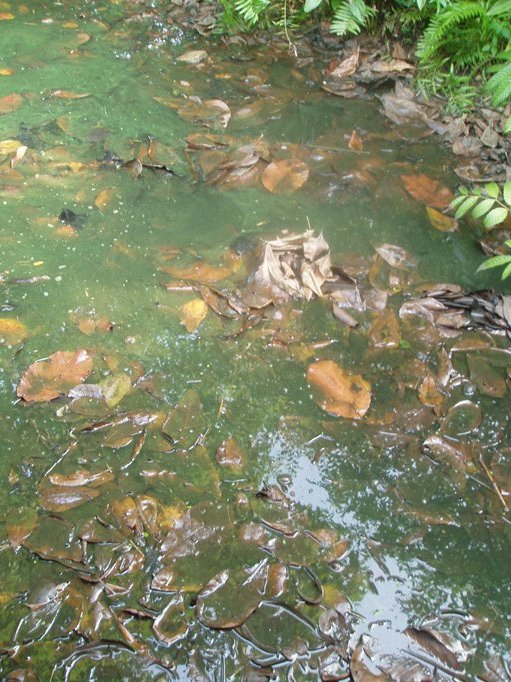
 Figure: Pond badly overgrown with "green" algae at Sungei Buloh Wetland Reserve (SBWR) (Mar 2011)


Figure: Another shot of the same pond in SBWR (Mar 2011)


With a sprinkling of scientific principles, here are my sentiments on curbing this tough guy.

First: scoping out your opponent
Find out who this tough guy really is. Algae comes in all sorts of flavours, from red, green, blue-green, brown to diatoms and dinoflagellates. To really nail it down to species level, you will need molecular techniques in well equipped labs. Since most of us do not have access to such high powered stuff, we will have to settle on visual examination under microscope. (I agree that most of us do not have a microscope stashed away at home either but at least most schools should have a few to play with.)
 Figure: Microcystis spp under 10x magnification

Figure: Anabaena sp under 10x magnification


Once you have an idea of your guy, check out his characteristics. How does he grow? What are his most important nutrients? Which nutrient is the limiting one? In the case of the above 2 algae, they normally bloom in an excess of phosphorus usually in the form of phosphate.

Second: scoping out your water
Hey, this is water quality blog so yes, you have to check out your water quality. The standard parameters include: dissolved oxygen (DO), electrical conductivity (EC), turbidity, pH, alkalinity, hardness, nitrate, ammonia, phosphate, biochemical oxygen demand (BOD), chemical oxygen demand (COD). Feel free to add more if you have the resources but the above should be a good starting point. Throw in chlorophyll a (a chemical found in algae) if you think you are up to it.

Go through your water quality data. Is there anything wrong besides the algae you observe? Anything amiss could point to some systemic problem that might have triggered the algal bloom. Following the above examples of Microcystis and Anabaena, the phosphate level is likely to be elevated.

Comparative studiesUnfortunately, it is hard to define what is meant by elevated in a natural environment impacted by numerous uncontrollable factors. One way is to make comparisons. Ideally, you should compare the same variable against time i.e. what was the phosphate level 1 year, 5 years, 10 years ago. Unfortunately, almost no one in Singapore (short of PUB in their reservoirs) does regular long term water quality monitoring (WQM) of their water bodies.

The alternative is to compare against a nearby "clean" water body. Since it is algae free, does it have a lower phosphate level?


Third: scope out your environment
Assuming you have discovered elevated phosphate level in your algae infested pond, ask: where does it come from? What are the sources of water flowing into your pond? Does surface run-off carry fertilisers from your next door vegetable farm neighbour into your pond?

You may have to check historical records too as your pond  may be sitting on an old farming area. If your pond sediment is choked full of phosphate from chicken waste from the previous chicken farm, you will have to get rid of the sediment.

I am all for long term solutions so learning the source of problem and tackling it at the source has always been my principle.


Fourth: ACT
As mentioned earlier, you may have the option of physical, chemical and biological methods.

Physical
Drain your pond and dredge out your sediment if it is the source of phosphate. You may also mechanically remove your algae via nets and filters

Chemical
Add alum or other chemicals (there are quite a few exotic ones in the market now) to bind the phosphate in your water into solid form and remove the solids.

Biological
By the nature of their operations (e.g. nature parks), some organisations are reluctant to use physical and chemical methods. Biological methods like phytoremediation appears appealing because of their naturalness. Yet, they may not pack the punch necessary to remove the nutrient (e.g. phosphate) sufficiently.
Other actions
Naturally, if the source of nutrient appears to come from your surroundings, you probably to get your neighbours into the picture to discuss ways to resolve your problem.

Thursday, December 02, 2010

Water quality in Sungei Buloh Wetland Reserve (SBWR)

I just found my article has been published in Wetlands. It has taken a long time to reach print so I must admit the data is slightly outdated (2008).


Overall, the water quality in SBWR was either relatively unpolluted or weakly polluted. Some concerns are raised regarding the levels of
dissolved oxygen (DO), phosphorus, nitrogen (ammonia and nitrate) and Escherichia coli. Regarding that last bit about E. coli, please do not comtemplate swimming in those waters as the E. coli count was sometimes found to be above the EPA limits for primary contact activities e.g. swimming. In case you are wondering where E. coli comes from, it is found in the human gut and normally enters water via human fecal matter. I guess you can imagine the rest. (See previous post on a similar indicator microbe, Enterococcus.)


Thursday, December 03, 2009

Yucks! What is that thing in my water?

All right, hands up, those of you who have seen "oily" patches like those in the 2 photos below. Let's count: 1, 2, 3...

Yes, they seem to be rather common in Singapore, whether in mangroves, streams, canals or ponds. And they appear throughout the year.

What are they? Are they natural or man-made? What are the ecological implications? Are they an indicator of water quality?


(Photo of Sungei Buloh Wetland Reserve (SBWR) by Anuj Jain 2009)


(Photo of Sungei Buloh Wetland Reserve (SBWR) by Anuj Jain 2009)

From the looks of the above photos, these "oil" patches could be caused by either real oil or certain metals (especially iron and manganese). To differentiate between them, try using a stick to disturb the patch. If it breaks up into smaller angular patches, it is likely to be metals. If the patch does not break but instead appears to follow your swirling, oil is present.


Iron and manganese are usually from the surrounding soils so yes, I would consider this natural.

Oils can also be from natural sources especially if nearby vegetation contains oils and somehow get into the water (pine oil, anyone?). A submerged dead animal can also produce oil from its fats.

Oils can be anthropogenic though. Without performing a lab analysis, it is difficult to differentiate between oils of natural and anthropogenic origins.

Ecologically, natural patches are probably harmless. Anthropogenic oil CAN be a problem, depending on its exact nature. Is it cooking oil, petrol, diesel, fuel oil or grease?

Yes, the appearance of oil in water can be an indicator of poor water quality but for most purposes, water quality is measured by a suite of parameters that can be quantified e.g. DO, oil content

Compare to the photo below. Even though there is a hint of an "oily" sheen, its characteristic colour (orangey) and angular fragments identify it as probably iron oxide. No prizes for guessing that it is similar to rust.

(Photo of a stream near Choa Chu Park by Robin 2009)

Thursday, July 23, 2009

Crocs in Singapore

When I was younger, I have always been skeptical of the presence of crocs in Singapore. But in recent times, sightings of these ancient creatures have been surfacing. Here is the latest documentation with a cool pic of the beast at Sungei Buloh in Biodiversity Singapore blog.

(from Biodiversity Singapore)

Wednesday, April 08, 2009

Field Day at Sungei Buloh Wetland Reserve (SBWR) (28 Mar 09)

A perfect day for water quality monitoring - the morning weather is bright with a good tide coming in - no lack of water for monitoring and sampling.


Students are all fired up for half a day of field work though they seem more interested in the surroundings than in their tasks of water quality monitoring. This is understandable considering that most of them have not set foot on SBWR. Neither have they ever set their sights on the insects, fishes, plants of a mangrove swamp. In a way, it is lamentable that our youth does not have the inclination or time to visit such natural areas but it also presents a great opportunity for Nparks and schools to work harder on their environmental education programmes.


Amazingly, some students confessed that they prefered a wilder area for a field trip e.g. "Ngee Ann Stream" where you have to bash your way through tall grasses and hurt your butt through slipping on mud. SBWR? "Too civilised for us"


As the day wore on and the sun reached its zenith, weariness grew on their faces... one started to see the standard "too tired to talk, too tired to think" behaviour. Perhaps the route we took has passed the point of diminishing returns. This is something to review for the next run of this module.


But something unexpected showed up to bring them back to full attention - a full blown shower with accompanying thunder with us stuck at the last sampling station and the visitor centre clearly out of sight. I consider this the highlight of the trip as it reminds us to respect nature. Nature does not care for your plans and to-do lists, it just does what it does but offers an exciting environment very different from the controlled conditions in a lab or classroom.

Figures (L-R, T-B): Checking out the resident fauna at the main bridge; clambering among the trees to get a good spot at the water edge; "environmental couple" at work; grand finale - sprinting back to the visitor centre, then the bus in bone drenching rain.