Showing posts with label Sungei Pandan. Show all posts

Tuesday, April 06, 2010

The forgotten mangroves at Sungei Pandan

Talk about mangroves in Singapore and you will hear about places like Sungei Buloh, Pasir Ris, Pulau Ubin and from the savvy ones, Sungei Sembawang, Sungei Punggol, Pulau Tekong. Only from the most experienced naturalists will you pick up whispers of Sungei Pandan. If you look up "Longman atlas: Singapore and the world", you won't even find mangroves there.

There is a very good reason too - Singapore's northern coast is well suited for mangrove building with gentle currents for sediment deposition. Yes, you need to have accumulation of the "yucky muck" for a good substrate. Sungei Pandan mangroves thus appears to be an odd orphan located near the southern coast. Could the conditions at Sg Pandan be similar to those of our northern coast?

I simply can't resist taking my advanced elective module (AEM) class to this interesting habitat for a water quality monitoring (WQM) field trip.

Figure: A massive dam lying right across Sg Pandan. Such dams are common on rivers and canals leading to the sea (Marina Barrage is the big brother among them). They control the loss of fresh water into the sea so that the reservoir (Pandan Reservoir in this case) can be pumped up. Another important function of a dam is to prevent the flow of seawater (read salty water) into the reservoir. Treatment of salty water is expensive since you need reverse osmosis or distillation to do the job. Conventional water treatment does not cut it.

But... (there is always a "but") these dams also disrupts the continuity of the flow, separating the stream into 2 parts with distinct characteristics, one of which being salinity. (1st hint: take note of the vegetation on the bank in the above figure.)

Bad for the aquatic life but great for an outdoor lesson. Here is a Google Earth file compiling the data collected by the participants.

Aside to FMSS students in selected groups: Please use this file to prepare for your case study presentation.

2nd, a dam may prevent precious sediment from reaching downstream. To you, sediment may be muck; to the creatures downstream, it is food, nutrients, home and more. Just as sediment is blocked, the migration of animals for spawning, feeding etc. across the great divide in both directions is also hindered. I am sure environmentalists all over the world have more to say about these dam problems (1, 2; Mekong - 3, 4).
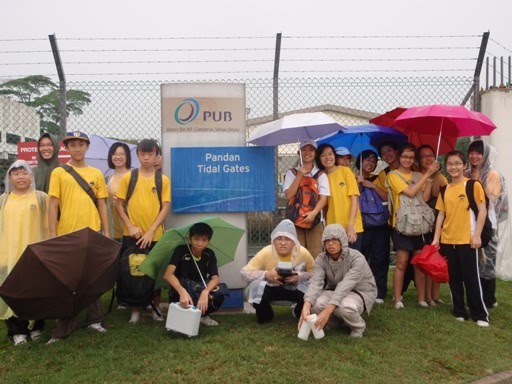
 
Figure: Steady rain for the whole field trip but what the heck, we are living in the tropics - rain is a standard feature. As long as safety is not compromised (e.g. lightning), some work in the rain is good for the spirit.


Figure: A denizen of the mangroves cleverly avoided the rain by following the guy with the umbrella

Figure: Downstream of the dam. Spot the different root systems of mangrove plants. The exciting mangroves in this figure is a vivid contrast to the boring grasses (no offence to the grass people) upstream.

Figure: Mudskippers surfacing to enjoy the cool rain which keeps their bodies comfortably moist.

Friday, January 29, 2010

Singapore Bug List

In response to queries from some readers regarding the types of bugs (macroinvertebrates) found in Singapore's fresh waters, I have compiled a quick list of the bugs I have encountered.

I have broadly classified our fresh water bodies into 3 types:

1. Ponds
Figure: A very stagnant pond next to Sungei Ulu Pandan


Figure: Turbid pond in the forest near Dover MRT station. (Sorry folks, if you intend to visit this one, forget it as the whole area is now under construction.)


Bugs present:
  1. Leeches! And big ones too! These are whoppers compared to the tiny terrestrial ones commonly encountered in Malaysian jungles. I was told that they are Buffalo Leeches (unverified).

    There are also tiny ones (fingernail sized).
  2. Dragonfly
  3. Damselfly
  4. Water stick insect
  5. Mayfly
  6. Pond skater
  7. Chironomid ("Bloodworm")
  8. Sludge worm
  9. Beetle
NO Caddisfly!

Unsurprisingly, when the dissolved oxygen (DO) level drops low (say below 2-3mg/L), the ponds become infested with leeches which crowd out the friendly bugs e.g. Mayflies.

2. Streams

Figure: Ngee Ann Stream riffles surrounded by secondary forest then. If you want to visit this wonderful stream, do it soon because the adjacent land is cleared and under construction (yawn, what else is new?). Who knows when the stream will be paved over to make way for yet another condominium?


Figure: Binjai Stream. A good old clear stream PROVIDED rains do not wash sediments into it.


Figure: Tributary into Sungei Pandan. This is a good example of a canal that looks like a natural stream.

Bugs present:
  1. Snail (lots of them in the tributary leading to Sg Pandan)
  2. Collembola
  3. Dragonfly
  4. Damselfly
  5. Eel
  6. Shrimp
  7. Crab (Binjai Stream. Yes, this stream is clean and natural enough to find crabs.)
NO Mayfly! NO Caddisfly!

3. Freshwater reservoir

Figure: MacRitchie Reservoir. Fully exposed to the sky.
Bugs present:

  1. Mayfly

  2. Dragonfly

  3. Damselfly

  4. Chironomid

  5. Shrimp

  6. Snail

  7. Lentil Shrimp

  8. Caddisfly
NO Leech!

Disclaimer: Haha, this is definitely not a complete list. All the above bugs are based on my experience in those waters.

Strangely, NO Plecoptera (Stonefly) and Megaloptera have been found so far in Singapore waters! These 2 orderse are supposed to be really common in other countries e.g. USA, UK.

Acknowledgement: Many thanks to Esther for introducing me to the world of water bugs! I am still learning lots more from her.

One last comment:
Forget about finding bugs in artificial fish ponds with little or no natural substrate - e.g. below

Wednesday, June 17, 2009

Advanced elective module (AEM): Water quality and pollution (8 - 15 Jun 09)

What an intense week! 6 consecutive days of conducting my AEM to W5 cluster of schools. Luckily, the AEM involves 3 field trips and 1 out-of-classroom lesson at the local pond. They certainly spice up the entire module. To make this post short and sweet, I will only include highlights of the module here.


Bug hunting. This time round, we gave SP Forest a miss as the whole area appeared to be under construction. Instead, we headed to a tributary of Sungei Pandan. This stream flows adjacent to AYE, next to International Business Park. Lots of snails, dragonfly nymphs, damselfly nymphs and fishes in the water. Even managed to scoop up a freshwater eel.


Back to my number one favourite haunt for water quality monitoring - Ngee Ann Stream. The place is fascinating for its variety of habitats which the stream passes - open country natural to secondary forest to open country urban. You even get to find riffles (so rare in our water bodies) in a part of the forest. As usual, we had our customary group photo at one of the more scenic spots.

Its educational value is also underscored by having 2 tributaries (1 from Clementi Road, another from Bukit Timah Road) joining up to hit Ulu Pandan Road. Based on the water quality data, the 2 tributaries have rather distinct personalities e.g. pH, turbidity, iron, alumuminium, conductivity. But of particular concern is the rather high pH (> 9) in the tributary from Bt Timah Rd. This was never observed in 2008 even though the values were consistent with the data collected in the previous week in a course for MOE (see earlier post). I will reserve my speculations till further data is available.


This time round, we tried a new field location - Sungei Pandan/ Pandan Mangroves. This is one of the rare mangrove swamps which is not found in the northern coast of Singapore. (Purists may argue that this is not a true mangrove as it does not possess all the defining vegetation and habitats but what the heck.)
Any scientific study in mangroves or coasts will have to check out the tides. We found ourselves in a rising tide but still at a relatively low level, meaning mud walking (or sinking) for all involved.
Found lots of Passiflora foetida growing wild and managed to sample some ripe fruits before the birds get to them.
This stretch of Sg Pandan is especially interesting as its flow is dammed by a set of sluice gates. The water quality data will immediately scream out the differences between the stretches before and after the gates, the most basic being one side having fresh water while the other side has salt water.


Some commonly seen activities of students: trying out the disposable glove in a way it is not designed for; drying out the feet when the shoes are wet