Monday, April 19, 2010

1-day course on water quality for teachers: My forest is dying and the role of water quality

Are you thinking of designing an out-of-classroom lesson for your students?

Have you considered water quality monitoring (WQM)? It can be tied to subjects like chemistry, geography and biology. Elements of community service and environmental education may also be incorporated in a WQM session.

There is currently much interest on water from the top (government). Perhaps because of this, much interest has been generated from the base (e.g. schools) too. In recent years, I have observed many projects on water quality, water treatment, wastewater treatment etc. from primary to tertiary level. Some projects were entered for competitions, some became community projects for developing countries while others aim to expose school students to the importance of water and water quality.

WQM involves checking the health of waterways on a regular basis. Whether in natural streams or urban canals, most of the water ends up in our reservoirs which provide our drinking water. Hence, WQM plays a vital role in safeguarding our water supplies.

WQM can become an on-going community service project. For schools in particular, WQM brings students into the field to experience real science and covers the part of their curriculum on environmental education and place based education (PBE).

If you are interested, you can find out more about the fascinating world of WQM in this course. Teachers and MOE staff may sign up for it via Traisi. For more details on the course, click here. Write-up of previous runs may be found here - 1, 2.

Course title: My forest is DYING and the role of water quality
Date: 2 June 2010 (Wed)
Time: 0900 - 1700
Venue: Singapore Polytechnic and in the field

Some further information:
I have regularly performed WQM with my polytechnic students since 2006. My publications include articles in Nature Watch and Nature News. I am currently continuing my WQM work with Nparks and Team Seagrass in Singapore's natural and coastal areas. My training courses (1, 2) on WQM have been regularly attended by students (primary, secondary, JC) and MOE teachers.

Tuesday, April 06, 2010

The forgotten mangroves at Sungei Pandan

Talk about mangroves in Singapore and you will hear about places like Sungei Buloh, Pasir Ris, Pulau Ubin and from the savvy ones, Sungei Sembawang, Sungei Punggol, Pulau Tekong. Only from the most experienced naturalists will you pick up whispers of Sungei Pandan. If you look up "Longman atlas: Singapore and the world", you won't even find mangroves there.

There is a very good reason too - Singapore's northern coast is well suited for mangrove building with gentle currents for sediment deposition. Yes, you need to have accumulation of the "yucky muck" for a good substrate. Sungei Pandan mangroves thus appears to be an odd orphan located near the southern coast. Could the conditions at Sg Pandan be similar to those of our northern coast?

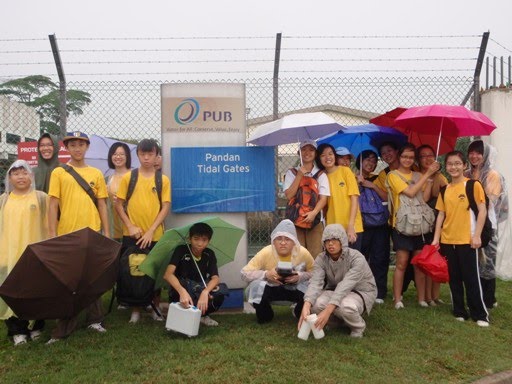
I simply can't resist taking my advanced elective module (AEM) class to this interesting habitat for a water quality monitoring (WQM) field trip.

Figure: A massive dam lying right across Sg Pandan. Such dams are common on rivers and canals leading to the sea (Marina Barrage is the big brother among them). They control the loss of fresh water into the sea so that the reservoir (Pandan Reservoir in this case) can be pumped up. Another important function of a dam is to prevent the flow of seawater (read salty water) into the reservoir. Treatment of salty water is expensive since you need reverse osmosis or distillation to do the job. Conventional water treatment does not cut it.

But... (there is always a "but") these dams also disrupts the continuity of the flow, separating the stream into 2 parts with distinct characteristics, one of which being salinity. (1st hint: take note of the vegetation on the bank in the above figure.)

Bad for the aquatic life but great for an outdoor lesson. Here is a Google Earth file compiling the data collected by the participants.

Aside to FMSS students in selected groups: Please use this file to prepare for your case study presentation.

2nd, a dam may prevent precious sediment from reaching downstream. To you, sediment may be muck; to the creatures downstream, it is food, nutrients, home and more. Just as sediment is blocked, the migration of animals for spawning, feeding etc. across the great divide in both directions is also hindered. I am sure environmentalists all over the world have more to say about these dam problems (1, 2; Mekong - 3, 4).
 
Figure: Steady rain for the whole field trip but what the heck, we are living in the tropics - rain is a standard feature. As long as safety is not compromised (e.g. lightning), some work in the rain is good for the spirit.


Figure: A denizen of the mangroves cleverly avoided the rain by following the guy with the umbrella

Figure: Downstream of the dam. Spot the different root systems of mangrove plants. The exciting mangroves in this figure is a vivid contrast to the boring grasses (no offence to the grass people) upstream.

Figure: Mudskippers surfacing to enjoy the cool rain which keeps their bodies comfortably moist.

Friday, March 26, 2010

Water from the sky... and we are not talking about rain

I saw this article ‘Sky water' plant a boon for people of Sidlaghatta (The Hindu, 22 Mar 2010) about "a new technology that is reportedly making waves in the U.S. and European countries". Put simply, it is a big condenser that converts the water vapour in the air (aka humidity) into clean liquid water, extremely useful for rural populations with no access to safe water.

Actually, don't you think this is similar to the Dragonfly from our local brand, Hyflux, introduced a few years back? Granted, the Dragonfly is designed for a small family/office (up to 24L per day according to specs) while this sky water plant can crank out 1000L per day, about suitable for a small village. Nevertheless, the operating principles are the same.

Cost wise... sky water costs 10 paise per litre (~ SGD3 per cubic metre (m3), 1 rupee = 100 paise). Our domestic tap water costs SGD1.52 per m3 (including tariff) while newater sold to industry costs SGD1 per m3. (Desalination costs about twice that of the newater process so the price probably follows suit. Based on a ST article in 2004, desalinated water costs SGD0.78/ m3.) No, sky water is not cheap by our standards but when water stands between life and death, any price is cheap.

Incidentally, I do have some concerns about this technology, especially when applied on a large scale, say for a town or (heaven forbid) a city. When you start to draw this large amount of moisture from the atmosphere, what are the effects on the water cycle? Will we have less precipitation which leads to less water for our reservoirs, hence ending up with a zero sum game? Will less moisture in the air lead to larger fluctuations in temperature between day and night since water vapour acts as a buffer in air temperature changes? What will our neighbours say - that we are stealing water from the air which is supposed to pass over them? And I am sure there are many other unintended consequences beyond my imagination.


Though the above scenarios sound far fetched at the moment, they do somewhat mirror the process of drawing groundwater in many countries. An excessive withdrawal will lead to all sorts of problems e.g. sinking land, salt water intrusion, dried up surface soil prone to combustion.